


The US automotive airbag electronics market is a critical segment of vehicle safety systems, focused on sensors, control units, and deployment modules that ensure airbags activate during collisions. It is driven by strict safety regulations, rising consumer demand for advanced safety features, and increasing vehicle production.Growth is also supported by advancements in automotive electronics, including smarter crash detection algorithms and integration with ADAS (Advanced Driver Assistance Systems).
The Automotive Airbag Electronics Market is experiencing steady growth driven by rising global emphasis on vehicle safety systems and stringent regulatory standards for passenger protection. Airbag electronics play a critical role in modern vehicles by controlling airbag deployment through sensors, control units, and crash detection algorithms. These systems ensure rapid and precise activation during collisions, significantly reducing the risk of injury to vehicle occupants.
According to The Insight Partners, advancements in automotive safety technologies and increasing integration of electronic control systems in vehicles are key factors supporting market expansion. The growing adoption of connected and smart vehicle platforms is further enhancing the role of airbag electronics in overall vehicle safety architecture.
Market Size and Forecast
Automotive Airbag Electronics Market Size and Growth Outlook
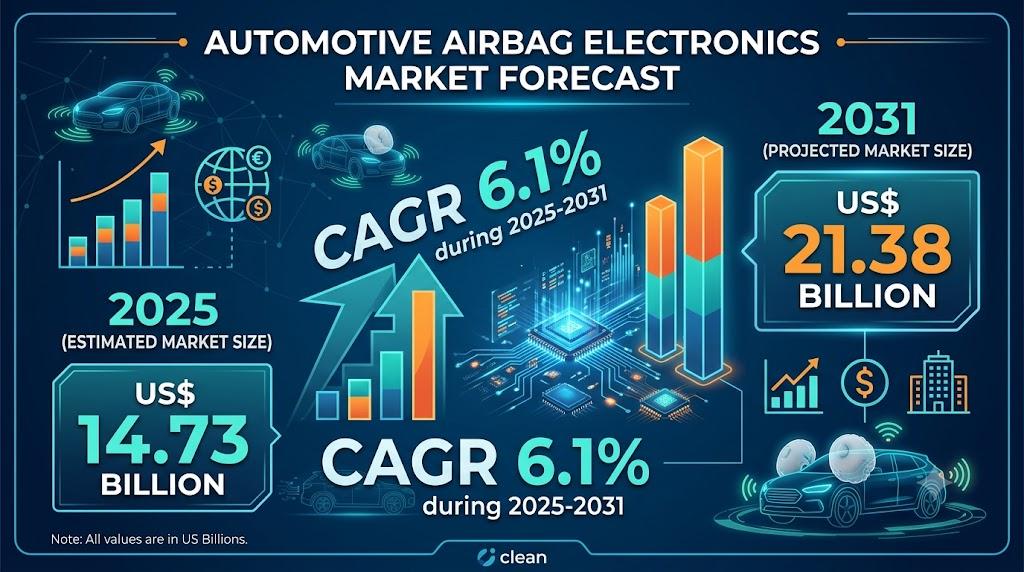
The Automotive Airbag Electronics Market size is expected to reach US$ 21.38 billion by 2031. The market is anticipated to register a CAGR of 6.1% during 2025-2031.
This growth reflects the increasing deployment of advanced safety systems across passenger vehicles and commercial vehicles. Automakers are integrating more sophisticated electronic control units that enhance crash detection accuracy and improve deployment timing. Rising consumer awareness regarding vehicle safety ratings and crash test performance is also contributing to higher adoption of airbag electronic systems.
The expansion of electric vehicles and autonomous driving technologies is further supporting market growth. These vehicles require highly reliable electronic safety architectures, where airbag electronics serve as a core component of occupant protection systems.
Market Drivers and Trends
One of the primary drivers of the Automotive Airbag Electronics Market is the implementation of strict government regulations mandating advanced safety features in vehicles. Regulatory bodies across regions are continuously enforcing crash safety norms, which is encouraging manufacturers to adopt improved airbag control systems.
Another significant factor is the increasing consumer preference for high safety rated vehicles. Automotive buyers are prioritizing vehicles equipped with advanced driver assistance systems and comprehensive passive safety features. This has led to greater integration of multi stage airbags, smart sensors, and advanced electronic control modules.
Technological advancements in microelectronics and sensor technology are also shaping the market. Modern airbag electronic systems are designed to process crash data in milliseconds using accelerometers, pressure sensors, and gyroscopic inputs. These improvements are enhancing deployment accuracy and reducing false activations.
Additionally, the rising production of vehicles in emerging economies is contributing to market expansion. As automotive manufacturing grows in Asia Pacific and other developing regions, demand for cost effective yet advanced safety systems is increasing steadily.
Download Sample Report: https://www.theinsightpartners.com/sample/TIPRE00004970
Key Players in the Automotive Airbag Electronics Market
-
Ashimori Industry Co. Ltd.
-
Autoliv Inc.
-
Continental AG
-
DENSO CORPORATION
-
Hyundai Mobis
-
Joyson Safety Systems
-
Nihon Plast Co., Ltd.
-
Robert Bosch GmbH
-
Toyoda Gosei Co., Ltd.
-
ZF Friedrichshafen AG
Future Outlook
The future of the Automotive Airbag Electronics Market is expected to be shaped by continuous innovation in vehicle safety technologies and increasing integration of intelligent electronic systems. As vehicles become more connected and autonomous, airbag electronics will evolve to support faster decision making and improved crash prediction capabilities.
Future systems are likely to incorporate advanced artificial intelligence and machine learning algorithms to analyze driving conditions and occupant behavior in real time. This will enable more adaptive airbag deployment strategies tailored to specific crash scenarios.
The growing penetration of electric and autonomous vehicles will further enhance demand for highly reliable and efficient airbag control modules. In addition, increasing collaboration between automotive manufacturers and electronics suppliers will support the development of next generation safety architectures. As safety standards continue to tighten globally, airbag electronics will remain a fundamental component of automotive safety systems, ensuring improved passenger protection and reduced accident fatalities.
Related Reports:
Electric Off-Road Vehicle Market
About Us
The Insight Partners is a leading global market research and consulting firm specializing in delivering actionable insights across various industries. Our research reports combine extensive primary and secondary research to provide accurate market intelligence, helping businesses make informed strategic decisions. The company provides detailed analysis on emerging technologies, market trends, competitive landscapes, and growth opportunities across sectors including technology, healthcare, manufacturing, and energy.
Contact Us:
Contact Person: Ankit Mathur
Email: ankit.mathur@theinsightpartners.com
Phone: +1-646-491-9876